
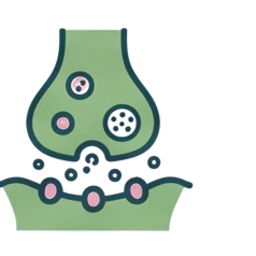
Neurons pass signals across tiny gaps called synapses, and much of what mental illness changes, and much of what treatment changes, happens at that junction.
The gap that carries a signal
The brain is made of vast networks of neurons, cells that pass signals to one another not by touching directly but across a tiny gap called a synapse. When a neuron fires, it releases chemical messengers, called neurotransmitters, into that gap; these drift across and lock onto receptors on the neighbouring neuron, which either encourages or discourages that neuron from firing in turn. Multiply this across enormous numbers of neurons and synapses, and the result is everything the brain does: movement, memory, mood and thought. This process happens with remarkable speed and precision, allowing the brain to coordinate everything from a reflex action to a complicated thought almost instantly.
Several different neurotransmitters are known to matter for mood, motivation and perception. Each tends to act like a slightly different kind of message, shaping different aspects of thinking and feeling rather than working as a simple "happy chemical" or "sad chemical". Communication in the brain depends on the balance and timing between several such systems working together, not any single system operating in isolation.
A system that keeps changing
Synapses are not fixed. The brain has a lifelong capacity, known as plasticity, to strengthen connections that are used often, weaken ones that are not, and grow new connections in response to experience, learning and, importantly, treatment. This helps explain why recovery from mental illness is a realistic expectation rather than a hopeful exception: the brain's wiring is not set in stone at any point in life, and it continues to respond to what a person does, learns and experiences. This same capacity for change is also why environment matters so much for mental health: supportive relationships, meaningful activity and reduced stress can all leave a lasting mark on the brain's wiring, in much the same way that adversity and prolonged stress can.
Where treatment fits in
Understanding synapses helps explain, in broad terms, why different treatments work the way they do. Many medications used in mental health act by adjusting how neurotransmitters are released, received or cleared away at the synapse, nudging an imbalanced system back toward a more typical range. Talking therapies work differently but are increasingly understood to have effects at this same level, changing patterns of connection built up through experience over time. Neither approach replaces the other; for many people the two are used together rather than as alternatives, and which mix fits is a conversation to have with a clinician. Researchers are still mapping exactly how different treatments influence particular circuits and systems, and this remains among the most active areas of mental health research, precisely because the synapse offers such a concrete point where a biological process and a person's lived experience meet.
The synapse is a small structure to carry so much explanatory weight, but it is where biology and the lived experience of mental health most directly meet.
It remains a topic the Society's clinicians and researchers find plenty to discuss.